
OptiMATE Gradient Maker: Creating a Continuous Gradient
Learn more about the OptiMATE Gradient Maker and discover how it can simplify gradient preparation for your workflow.
Explore the OptiMATE Gradient MakerTrascrizione
Select create a new method. We will create the method using the create a new gradient template option, and we will give it a name.
We will call this sucrose, short for continuous, rad, and select create.
We can also use the duplicate based on existing method option to create new methods based on methods already created.
Now that we have this method available as a draft, we select the edit button.
The editing test method page will open.
When editing a method, every change will be automatically saved.
Under the general tab, it gives you options related to the tube closure type, tube material, and sterile or standard variants.
Based on your selection, the part number is automatically populated.
Choose the volume from the drop-down menu.
Select the heat seal option if you wish to seal tubes after dispense.
This option will be selectable only for quick seal tubes.
Select the default number of tubes from the drop down menu.
Toggle allow a variable number of tubes to change the number of tubes to be created when preparing gradients.
This is necessary if the number of tubes to be prepared each time is varied.
Select the reagents tab. Under this tab, we select the reagents to be used for the experiment and assign them to specific pumps.
In this case, water for pump one and the gradient modifier in pump four, which is sucrose. If fewer than four pumps are needed, select pump not used for the remaining pumps.
Reagent must always be assigned to pump one, and the gradient modifier must be assigned to pump four.
Once these are populated, we proceed to the sections tab to define the composition of the gradient tubes.
Each section corresponds to one step or one layer in the entire step gradient.
For the purposes of this demonstration, we will define just one continuous or linear gradient section through the entire length of the tube.
Under section one, we select the pencil icon to edit it.
The section volume will be the entire thirty-nine mL, the content of the tube.
We will allow the section density to be computed automatically.
To generate a linear gradient, we click on the three dots next to the sucrose edit reagent section.
This will allow for us to change the distribution type to linear, which we will go ahead and do.
Two boxes will appear to enter the bottom and top values of the linear gradient. In this demonstration, we will use sucrose concentration to define the upper and lower limits of the gradient.
We enter five percent sucrose as the lower limit and thirty-five percent sucrose as the upper limit.
We will click on the three dots next to the water and select compute target.
The software will automatically compute the amount of water dispensed with the sucrose to generate the linear gradient.
Once done, we save the section. As part of this, the OptiMATE Gradient Maker software also verifies if the method is entered correctly.
It will also give you an average tube density, which in this case is one point zero nine grams per mL.
The method can be examined visually by selecting the view tube composition method.
To use the method, we click close and select the back button.
Since the method is already saved, select publish to access the method from the run gradient method option.
Video correlati
OptiMATE Gradient Maker
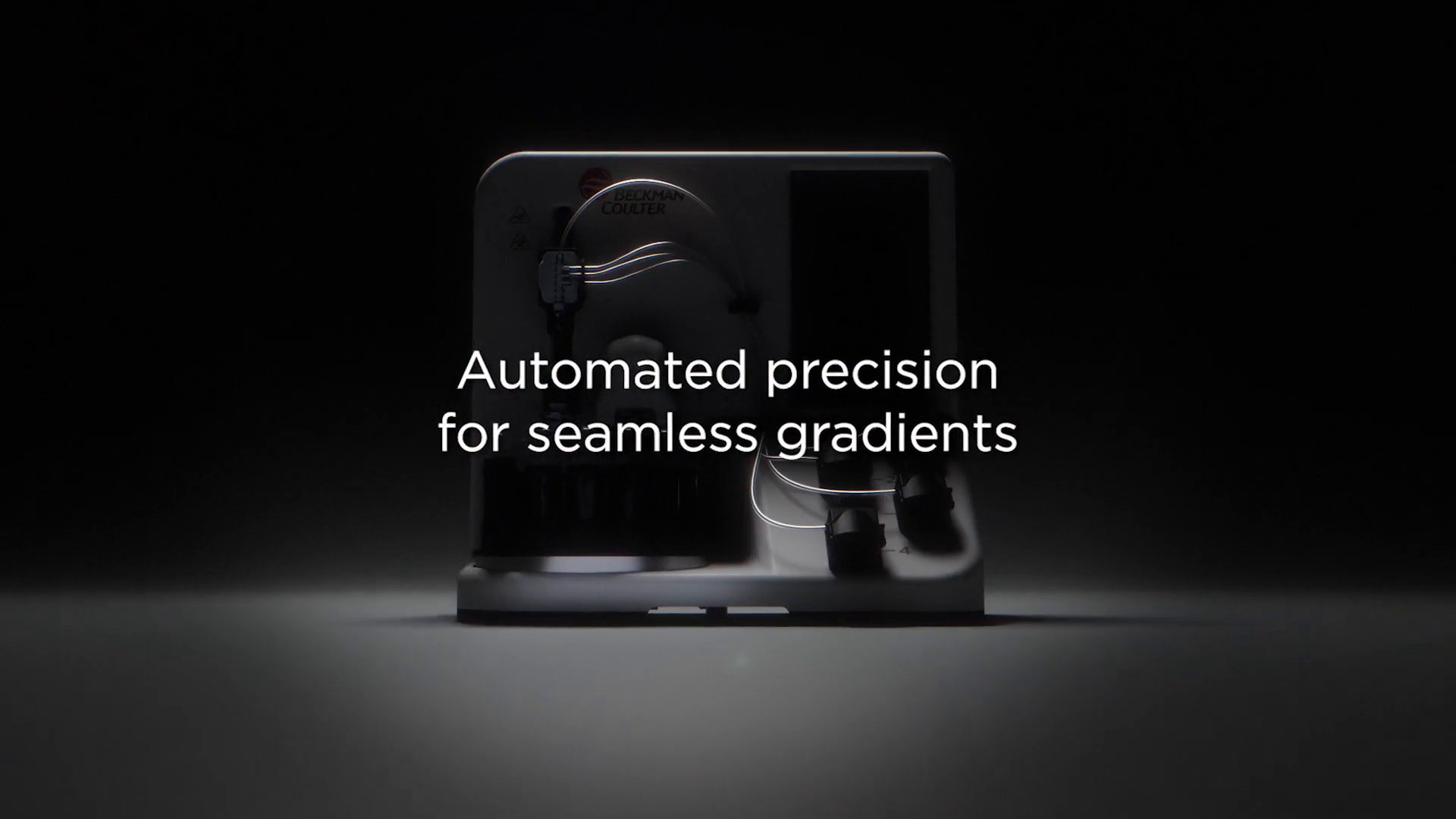
The OptiMATE Gradient Maker simplifies the laborious and error-prone density gradient ultracentrifugation (DGUC) process into an easy-to-maintain operation by automating nearly all pre-centrifuge steps, including gradient preparation, tube sealing, and accurate dispensing, significantly reducing run times without sacrificing purity or yield.

OptiMATE Gradient Maker Features
The OptiMATE Gradient Maker simplifies the laborious and error-prone density gradient ultracentrifugation (DGUC) process into an easy-to-maintain operation by automating nearly all pre-centrifuge steps, including gradient preparation, tube sealing, and accurate dispensing, significantly reducing run times without sacrificing purity or yield.
