ViaKrome Fixable Viability Dye Staining Protocol
Materials
- PBS
- Fetal Bovine Serum
- PerFix-nc Reagent 1, 2 and 3 (Part Number B10825)
- PBS with 0.5% formaldehyde
Cell Lines
- Use cell lines at 5 x 10⁶ cells per mL, 100 μL per test (5 x 10⁵ cells per test)
- Add 2.5 uL*of ViaKrome Fixable Viability Dye
- Vortex
- Incubate at 18-25 °C protected from light for 20 minutes
- Add 3 mL of PBS 1X
- Centrifuge 5 minutes at 300 g
- Aspirate the supernatant
- Add 500 μL of PBS 1X / formaldehyde 0.5%
- Acquire data using a flow cytometer
*For the use with other protocols and/or samples, a titration of the ViaKrome Fixable Viability Dye is recommended to establish the optimal dose.

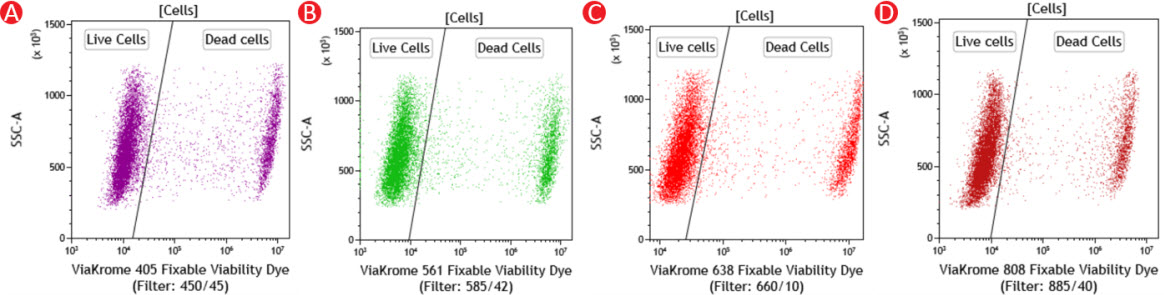
Representative Staining using ViaKrome Fixable Viability Dyes. Bi-parametric representation (Side scatter versus Fluorescence intensity) of the staining of a mixture untreated cells (Live Cells) and heat-treated Jurkat cells (Dead Cells). Acquisition is done with a CytoFLEX LX N-V-B-Y-R-I Series flow cytometer and emission was detected via the indicated bandpass filter. ViaKrome 405 Dye was excited with the Violet laser (405 nm), panel A, ViaKrome 561 Dye excited with the Yellow Green laser (561 nm), panel B, ViaKrome 638 Dye was excited with the Red laser (638 nm), panel C, and ViaKrome 808 was excited with the Infrared laser (808 nm), panel D.
Peripheral Blood Mononuclear Cells (PBMCs)
- Add 2.5 μL of ViaKrome Fixable Viability Dye in 50 μL PBMCs at 10 x 106 cells/mL
- Vortex
- Incubate at 18-25 °C protected from light for 20 minutes
- Add 3 mL PBS 1X
- Centrifuge 150 g for 5 minutes. Remove the supernatant by aspiration
- Add 50 μL Fetal Bovine serum. Vortex until pellet is dissociated.
- Proceed with Intracellular Staining
*For the use with other protocols and/or samples, a titration of the ViaKrome Fixable Viability Dye is recommended to establish the optimal dose.

Representative Staining using ViaKrome Fixable Viability Dyes. Bi-parametric representation (Side scatter versus Fluorescence intensity) of the staining of peripheral blood mononuclear cells (PMBC). Acquisition is done with a CytoFLEX LX N-V-B-Y-R-I Series flow cytometer and emission was detected via the indicated bandpass filter. ViaKrome 405 Dye was excited with the Violet laser (405 nm), panel A, ViaKrome 561 Dye excited with the Yellow Green laser (561 nm), panel B, ViaKrome 638 Dye was excited with the Red laser (638 nm), panel C, and ViaKrome 808 was excited with the Infrared laser (808 nm), panel D.
Helpful Links
-
Flow Cytometry Reagents
-
Antibodies & Kits
-
Anticorpi a Singola Marcatura
- Panel Design
- Product Listings and Catalogs
- Isotype Controls
- Quality Standards
- APO2.7 (7A6) Antigen
- Beta2-Microglobulin Antigen
- CD10 Antigen
- CD103 Antigen
- CD105 Antigen
- CD106 Antigen
- CD107a (LAMP-1) Antigen
- CD109 (E123) Antigen
- CD116 (GM-CSFR) Antigen
- CD117 (c-kit) Antigen
- CD11a Antigen
- CD11b Antigen
- CD11c Antigen
- CD120b (TNF-R2) Antigen
- CD122 (IL-2Rß) Antigen
- CD123 (IL-3Rα) Antigen
- CD126 (IL-6Rα) Antigen
- CD127 (IL-7Rα) Antigen
- CD13 Antigen
- CD133 Antigen
- CD134 (OX 40) Antigen
- CD135 (flt3/flk2) Antigen
- CD137 Antigen
- CD138 Antigen
- CD14 Antigen
- CD141 (BDCA-3) Antigen
- CD144 (VE-Cadherin) Antigen
- CD146 Antigen
- CD15 Antigen
- CD152 (CTLA-4) Antigen
- CD154 Antigen
- CD157 Antigen
- CD158a,h Antigen
- CD158b1/b2,j Antigen
- CD158e1/e2 Antigen
- CD158f (KIR2DL5) Antigen
- CD158i Antigen
- CD159a Antigen
- CD16 Antigen
- CD160 Antigen
- CD161 (NKR-P1A) Antigen
- CD166 (ALCAM) Antigen
- CD16b Antigen
- CD18 Antigen
- CD180 Antigen
- CD183 (CXCR3) Antigen
- CD184 (CXCR4) Antigen
- CD19 Antigen
- CD196 (CCR6) Antigen
- CD197 (CCR7) Antigen
- CD1a Antigen
- CD1c Antigen
- CD2 Antigen
- CD20 Antigen
- CD200 Antigen
- CD203c Antigen
- CD206 (MMR) Antigen
- CD207 (Langerin) Antigen
- CD208 (DC-LAMP) Antigen
- CD209 (DC-SIGN) Antigen
- CD21 Antigen
- CD22 Antigen
- CD23 Antigen
- CD235a (Glycophorin A) Antigen
- CD24 Antigen
- CD243 (P-glycoprotein) Antigen
- CD244 (2B4) Antigen
- CD25 Antigen
- CD26 Antigen
- CD27 Antigen
- CD274 (PD-L1) Antigen
- CD278 (ICOS) Antigen
- CD279 (PD-1) Antigen
- CD28 Antigen
- CD29 Antigen
- CD294 (CRTH2) Antigen
- CD3 Antigen
- CD30 Antigen
- CD300a (IRp60) Antigen
- CD305 (LAIR1) Antigen
- CD309 (KDR) Antigen
- CD31 Antigen
- CD314 (NKG2D) Antigen
- CD32 Antigen
- CD326 (EpCAM) Antigen
- CD328 (p75 AIRM1) Antigen
- CD33 Antigen
- CD335 (NKp46) Antigen
- CD336 (NKp44) Antigen
- CD337 (NKp30) Antigen
- CD34 Antigen
- CD35 Antigen
- CD352 (NTB-A) Antigen
- CD36 Antigen
- CD37 Antigen
- CD370 (Clec9A) Antigen
- CD38 Antigen
- CD39 Antigen
- CD4 Antigen
- CD40 Antigen
- CD41 Antigen
- CD42a Antigen
- CD42b Antigen
- CD43 Antigen
- CD44 Antigen
- CD45 Antigen
- CD45RA Antigen
- CD45RO Antigen
- CD48 Antigen
- CD49b Antigen
- CD49d Antigen
- CD49e Antigen
- CD5 Antigen
- CD52 Antigen
- CD54 Antigen
- CD55 Antigen
- CD56 Antigen
- CD57 Antigen
- CD58 Antigen
- CD59 Antigen
- CD6 Antigen
- CD61 Antigen
- CD62L Antigen
- CD62P Antigen
- CD63 Antigen
- CD64 Antigen
- CD65 Antigen
- CD66b Antigen
- CD66c (KOR-SA3544) Antigen
- CD69 Antigen
- CD7 Antigen
- CD71 Antigen
- CD73 Antigen
- CD77 Antigen
- CD79a Antigen
- CD79b Antigen
- CD8 Antigen
- CD80 Antigen
- CD81 Antigen
- CD83 Antigen
- CD85d (ILT4) Antigen
- CD85j (ILT2) Antigen
- CD85k (ILT3) Antigen
- CD86 Antigen
- CD8β Antigen
- CD9 Antigen
- CD90 Antigen
- CD94 Antigen
- CD95 Antigen
- CD99 Antigen
- Cyclin A2 Antigen
- Cytokeratin Antigen
- DAP12 (DNAX / KARAP / TYROBP) Antigen
- FMC7 (CD20) Antigen
- FoxP3 Antigen
- Granzyme B Antigen
- Helios Antigen
- HIV-1 Core Antigen
- HLA-ABC Antigen
- HLA-DQ Antigen
- HLA-DR Antigen
- HLA-DR, DP, DQ Antigen
- IFN-γ Antigen
- IgD Antigen
- IgE (Dε2) Antigen
- IgM Antigen
- IL-17A Antigen
- IL-2 Antigen
- IL-4 Antigen
- Kappa Chain Antigen
- Ki-67 Antigen
- Lactoferrin Antigen
- Lambda Chain Antigen
- Myeloperoxidase Antigen
- NG2 (7.1) Antigen
- NKp80 Antigen
- OSCAR Antigen
- Perforin Antigen
- ROR1 Antigen
- TCR PAN α/β Antigen
- TCR PAN γ/δ Antigen
- TCR Vα7.2 Antigen
- TCR Vα24 Antigen
- TCR Vβ1 Antigen
- TCR Vβ2 Antigen
- TCR Vβ3 Antigen
- TCR Vβ4 Antigen
- TCR Vβ5.1 Antigen
- TCR Vβ5.2 Antigen
- TCR Vβ5.3 Antigen
- TCR Vβ7.1 Antigen
- TCR Vβ7.2 Antigen
- TCR Vβ8 Antigen
- TCR Vβ9 Antigen
- TCR Vβ11 Antigen
- TCR Vβ12 Antigen
- TCR Vβ13.1 Antigen
- TCR Vβ13.2 Antigen
- TCR Vβ13.6 Antigen
- TCR Vβ14 Antigen
- TCR Vβ16 Antigen
- TCR Vβ17 Antigen
- TCR Vβ18 Antigen
- TCR Vβ20 Antigen
- TCR Vβ21.3 Antigen
- TCR Vβ22 Antigen
- TCR Vβ23 Antigen
- TCR Vδ1 Antigen
- TCR Vδ2 Antigen
- TCR Vγ9 Antigen
- TCR ζ Antigen
- TdT Antigen
- Thrombin Receptor Antigen
- TIA-1 Antigen
- TNF Alpha Antigen
- ZAP-70 Antigen
- Miscele anticorpali a 2-4 colori
- Reagenti AQUIOS
- ClearLLab Antibody Solutions
- DURAClone Panels
- Sistemi e kit per Clinica/Ricerca Clinica
-
Anticorpi a Singola Marcatura
-
Cell Health and Research Assays
- Cell Cycle Kit
- Cell Cycle Flow Cytometry Assay Principle
- Streamlined Workflow for Cell Cycle Analysis
- Cell Cycle Staining Protocol
- Advanced Cell Cycle Analysis
- Propidium Iodide Spectrum
- Cell Cycle Kit Performance
-
ViaKrome Fixable Viability Dyes
- Comparison of NHS ester-based reagents to ViaKrome Fixable Viability Dye
- Flexibility for Multicolor Panel Design
- Robust Performance
- ViaKrome Fixable Viability Dye Staining Protocol
- Why Use a Viability Dye?
- DNA Binding Dyes
- Apoptosis Reagents
- Research Assays
- Lysing, Fixative, and Permeabilizating Reagents
- Fluorospheres & Quality Control
- Servizio Custom Reagent
-
Antibodies & Kits
-
Cell Health and Research Assays
- Cell Cycle Kit
- Cell Cycle Flow Cytometry Assay Principle
- Streamlined Workflow for Cell Cycle Analysis
- Cell Cycle Staining Protocol
- Advanced Cell Cycle Analysis
- Propidium Iodide Spectrum
- Cell Cycle Kit Performance
-
ViaKrome Fixable Viability Dyes
- Comparison of NHS ester-based reagents to ViaKrome Fixable Viability Dye
- Flexibility for Multicolor Panel Design
- Robust Performance
- ViaKrome Fixable Viability Dye Staining Protocol
- Why Use a Viability Dye?
- DNA Binding Dyes
- Apoptosis Reagents
- Research Assays
-
ViaKrome Fixable Viability Dyes
- Comparison of NHS ester-based reagents to ViaKrome Fixable Viability Dye
- Flexibility for Multicolor Panel Design
- Robust Performance
- ViaKrome Fixable Viability Dye Staining Protocol
- Why Use a Viability Dye?
-
Flow Cytometers, Cell Sorters and Cell Preparation Systems
- Sistema di citometria a flusso AQUIOS CL
- Citometro a flusso Navios EX
- Citometro a flusso DxFLEX
-
Citometro a flusso CytoFLEX
- CytoFLEX Startup User Guide
- Release Notes
- CytExpert Tools for 21 CFR Part 11 Compliance
- Compensation
- Consumables for the CytoFLEX Platform
- Focus
- Nanoparticle Detection
- Expand Violet, UV, or Near UV Channels with the CytoFLEX LX WDM Beam Splitter
- The CytoFLEX Platform
- Exquisite Sensitivity
- CytExpert Software for the CytoFLEX Platform
- CytoFLEX Technology
- Citometro a flusso CytoFLEX S
- Citometro a flusso Cytoflex LX
- MoFlo Astrios Cell Sorter
- Citometro a flusso Navios 10/3
- Gallios Flow Cytometer
- MoFlo XDP Cell Sorter
- nizonPLUS Cell Washer
- TQ-Prep Workstation
- Workstation PrepPlus 2
-
Flow Cytometry Software
- AQUIOS Designer Software
-
Software di analisi Kaluza
-
Kaluza Learning Center
- Using Advanced Plot Types in Kaluza: Comparison Plots for Visualization of the TCR V Beta Repertoire
- Getting Started with Kaluza: Data Scaling and Compensation Adjustment
- Use the Kaluza Cytobank Plugin to Upload Processed Files to the Cloud for Further Analysis
- Getting Started with Kaluza: Loading Files and Creating Plots
- Getting Started with Kaluza: Overlays
- Kaluza Analysis Tree Plots Offer a Fast and Comprehensive Overview of Multicolor Flow Cytometry Data
- Analyze Your Flow Cytometry in Real Time with Kaluza
- Istruzioni per l’installazione
- Kaluza Software Troubleshooting
- Kaluza Free Trial Download
- Build Analysis Workflows by Combining the Power of Kaluza Analysis Software and the Cytobank Platform
- Note di rilascio
- Kaluza Cytobank Plugin Download
- R Console Plugin for Kaluza Analysis
- Analisi offline
- Download
- Caratteristiche di Kaluza
-
Kaluza Learning Center
- Kaluza C Analysis Software
- Kaluza for Gallios